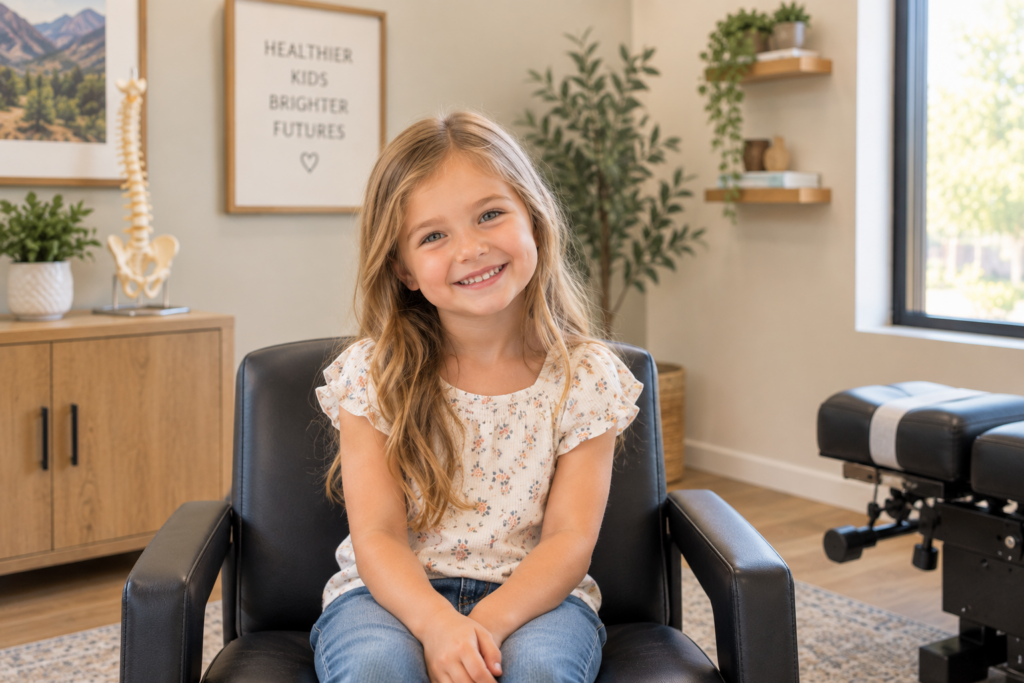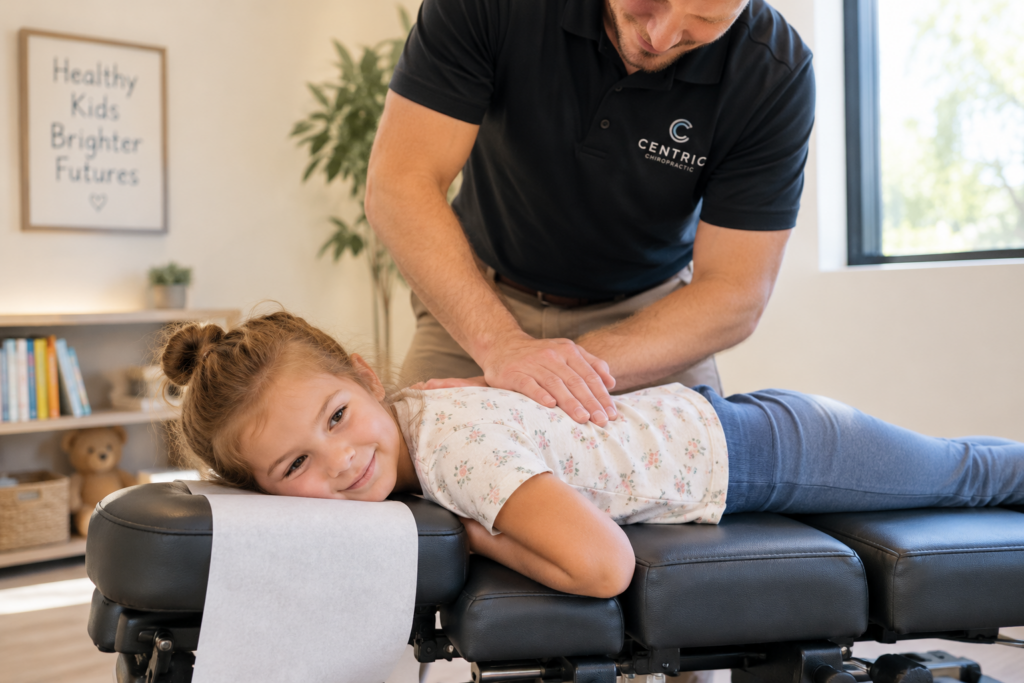


What Happens When Kids Get Adjusted. A Lot.
A Guide to Pediatric Chiropractic Care at Centric Chiropractic in Gilbert, AZ — What We Find, What We Do, and What Changes
Centric Chiropractic | Gilbert, AZ | Serving Chandler, Mesa & Queen Creek
🛑 Scope of Practice Disclaimer
The information in this article is for educational purposes only and does not constitute medical advice. Chiropractic care, as practiced at Centric Chiropractic, does not diagnose, treat, or cure any disease, illness, or medical condition in children or adults. The sole focus of chiropractic care is the detection and correction of vertebral subluxations — areas of spinal dysfunction that create interference in the nervous system. Any improvements observed in children under chiropractic care reflect the body’s own innate capacity to self-regulate when nervous system interference is reduced. Chiropractic care does not replace your child’s pediatrician. Please consult your child’s physician regarding any medical condition or concern.
We adjust a lot of kids.
Newborns. Crawlers. Wobbly toddlers who have fallen more times today than most adults fall in a year. Seven-year-olds who have been complaining of headaches for weeks that no one can explain. Twelve-year-old swimmers with shoulder tension their coaches have noticed. Teenagers who play competitive sports six days a week and whose bodies are quietly accumulating a structural debt that will present the bill later if we do not address it now.
Pediatric chiropractic care is a significant part of what we do at Centric Chiropractic in Gilbert. Not as a side offering. Not as an occasional request. It is woven into the daily rhythm of our clinic because the families of the East Valley have discovered something the conventional healthcare model rarely tells them: the nervous system of a developing child responds to chiropractic care in ways that are both meaningful and observable. And once a family sees it, they do not stop.
This post is about what actually happens when we work with kids. What we look for. What we find. What the adjustment involves. And what parents come back and tell us — week after week, visit after visit — has changed.
What We Are Actually Looking for When a Child Comes In
Every child who comes to our Gilbert clinic starts with the same foundation: we want to understand their nervous system. Not their symptoms. Their nervous system.
We do that by assessing the spine for vertebral subluxations — areas where the spinal segments have lost their normal motion or alignment in a way that creates interference in the nervous system. The nervous system runs through and out of the spine at every level. When a spinal segment is restricted or misaligned, the nerve signals passing through or adjacent to that segment are impaired. That impairment has consequences that ripple outward from the spine into the systems the nervous system governs — which, in a child, is everything.
Our assessment of a child’s spine involves:
· A thorough birth and health history from the parents — because the story of how this child got here tells us where to look
· Observation of the child’s posture, movement quality, and how they hold their head and body — the spine communicates its state through posture and movement before any hands touch it
· Palpation of the spinal segments — feeling for areas of restriction, muscle guarding, tenderness, and abnormal tissue tone that indicate where subluxations are present
· Range of motion assessment appropriate to the child’s age and cooperation level
· Evaluation of specific reflexes and neurological signs when indicated by the clinical picture
What we find varies enormously by age and history. A two-week-old whose birth involved forceps almost always has upper cervical restriction. A six-year-old who fell off the monkey bars three months ago and has had a stiff neck since may have a fixation in the mid-cervical spine that was never evaluated. A fourteen-year-old who has been playing competitive soccer year-round for four years has a predictable pattern of sacroiliac and lumbar restriction from the repetitive kicking mechanics. The presenting story and the clinical findings align more often than not.
We are not guessing and we are not following a script. Every assessment is specific to the child in front of us. What we find dictates what we do. And what we do is always calibrated to the age, size, and nervous system of that particular child on that particular day.
What the Adjustment Actually Involves — by Age
Parents who have not been adjusted themselves — or who have only seen adult chiropractic care — often arrive with significant uncertainty about what we are going to do with their child. The honest answer is: nothing like what you are picturing.
The corrective inputs we use with children are calibrated with a precision that most parents do not expect. Here is what that looks like across the age groups we see every day.
Newborns: Days to Weeks Old
A newborn chiropractic assessment and adjustment is one of the most understated clinical interventions you will ever witness. The pressure applied to a newborn’s restricted spinal segment is less than what you would use to check whether a tomato is ripe. There is no high velocity, no audible release, no visible movement of the spine. What happens is a sustained, specific contact over the restricted segment — a signal to the joint and the nervous system that creates a neurological shift without any mechanical force that would be concerning for a structure as new and as delicate as a newborn spine.
Most newborns sleep through it. Those who are awake often become visibly calmer during the contact. Parents who watch for the first time frequently say some version of: “That’s it? That’s all you did?” Yes. And it is often enough.
Infants: Two to Twelve Months
As babies develop head control, begin rolling, and start the process of getting mobile, the assessment becomes more interactive. We work with the baby’s natural movement rather than positioning them into stillness. Adjustments in this age group often involve the child on a parent’s chest or lap, in whatever position is most comfortable. The contacts are still light and specific. The sessions are short. Most babies tolerate them better than a diaper change.
Toddlers: One to Three Years
Toddlers are the wildcard of pediatric chiropractic care, and we mean that affectionately. They are curious, mobile, opinionated, and completely uninterested in the clinical agenda. We have adjusted toddlers who were simultaneously trying to eat the table paper, escape off the edge of the table, and narrate the experience in a language only they understood. We work with this. The assessment and adjustment are adapted to wherever the child is comfortable — standing at the table, on a parent’s lap, lying down, sitting up. The contacts are quick and specific. Most toddlers are done before they have decided whether to object.
School-Age Kids: Four to Ten Years
This age group is often the most enjoyable to work with. They are old enough to understand a simple explanation, curious enough to ask questions, and cooperative enough to make the visit efficient. We can do a more complete assessment with school-age children, and the findings at this age often reflect the accumulated structural impact of years of school posture, screen habits, and physical activity. Many kids this age have forward head posture patterns that have been building since they started kindergarten. Correcting these patterns at eight or nine is dramatically more straightforward than at eighteen or thirty-eight.
Adolescents: Eleven to Seventeen Years
Teenagers receive care that approaches adult care in technique, with the ongoing consideration that the skeleton is still maturing and the adolescent growth spurt creates specific windows of structural vulnerability. Teenagers who have been coming in since childhood have consistently better spinal mobility and structural symmetry than age-matched peers who are starting for the first time. The investment of the earlier years is plainly visible in the state of the adolescent spine.
Searching for “kids chiropractor Gilbert AZ,” “infant chiropractic adjustment East Valley,” “chiropractic for toddlers Gilbert,” or “pediatric chiropractic Chandler Mesa Queen Creek?” Centric Chiropractic in Gilbert works with children at every stage of development. Call us and we will walk you through exactly what to expect.
The Reason This Works: The Nervous System Runs Everything
Parents who see meaningful changes in their children after beginning chiropractic care frequently ask us to explain why. Why does adjusting the upper cervical spine of a three-month-old change how she sleeps? Why does correcting a lumbar restriction in a five-year-old affect how often he gets stomach aches? Why does addressing thoracic subluxation in a teenager change how quickly she recovers between swim practices?
The answer is always the same: the nervous system runs everything.
The spine is the physical housing of the central nervous system’s primary highway — the spinal cord and the nerve roots that branch from it to every organ, gland, muscle, and tissue in the body. When a spinal segment is subluxated, the nerve signals passing through or adjacent to that segment are impaired. Not severed. Not blocked entirely. Impaired. Dimmed. Running below their designed capacity.
In a child, those dimmed signals are not just affecting current function. They are affecting development. The nervous system of a child is not a finished product — it is an active construction project. The brain and nervous system build their architecture in response to the sensory input they receive. When the input from the spine is degraded by subluxation, the neural development that depends on that input is correspondingly imprecise.
We believe correcting the subluxation restores the quality of that input. The nervous system receives a clearer signal. And a nervous system with a clearer signal regulates better — sleep, digestion, immune function, emotional regulation, motor coordination, and the developmental processes that underpin all of them.
📊 A 2024 study from the Australian Spinal Research Foundation evaluated 37 children undergoing chiropractic care for subluxation correction and found measurable improvements in brain development markers compared to control groups — providing objective evidence that subluxation correction in children has neurological effects beyond the structural level (ASRF, 2024).
📊 Research published in PMC in 2024 found that chiropractic adjustments produce neuroplastic changes in brain regions associated with autonomic regulation and self-monitoring — changes that compound with consistent care over time (Haavik et al., 2024).
This is not alternative medicine. This is neuroanatomy. The spine and the nervous system are not separate systems. They are one integrated system. Caring for one is caring for the other.
The Questions Parents Ask Us Most — Answered Directly
Will it hurt my child?
The corrective contacts used in pediatric chiropractic care are calibrated precisely for the age and size of the child. For newborns and infants, the pressure is lighter than what most parents use when they hold their baby’s head. For toddlers and school-age children, the force is a fraction of what we use with adults. Most children do not react with distress during an adjustment. Many relax. The visits that involve any fussing are usually the initial visits with a child who is simply processing a new environment — not a child who is being hurt.
How do I know if my child needs it?
The honest answer is that most children would benefit from a periodic spinal assessment whether they have obvious symptoms or not. The spine accumulates stress from the very first day of life and continues accumulating it with every physical experience of childhood. The only way to know the state of your child’s spine is to have it assessed by someone who knows what to look for.
That said, the signs that most commonly prompt parents to make an initial appointment include: a difficult delivery, head tilt or preference for turning to one side, colic or digestive irregularity, sleep difficulty that is inconsistent with the child’s age, recurring illness, frequent headaches, complaints of neck or back discomfort, and persistent recovery from a fall or sports impact that should have resolved faster.
How many visits will it take?
This depends entirely on what we find and how long the subluxation patterns have been present. A newborn with birth-related upper cervical restriction often responds within a few visits. A seven-year-old who has had chronic headaches for two years and significant cervical subluxation may need several weeks of more frequent visits before the pattern is fully corrected and holding. We will tell you at the initial assessment what we find, what we recommend, and what to expect — honestly and specifically.
Can I stay in the room?
Yes. Always. We encourage parents to stay present during their child’s visit. We walk you through what we are finding and what we are doing in real time. There are no closed doors and no mystery. Your presence keeps your child calm and gives you the direct understanding of your child’s spinal health that allows you to make informed decisions about their ongoing care.
What if I just want it checked and there’s nothing wrong?
That is one of the best reasons to come in. If the assessment finds nothing significant, we tell you that and you leave knowing your child’s spine is in good shape. If we find something worth addressing, you leave with a plan. Either way you leave with information you did not have before. That has value regardless of what we find.
What Changes: What Parents Come Back and Tell Us
We do not make promises about specific outcomes. Every child’s nervous system responds in its own way, in its own time. What we can share is the consistent pattern of what parents across Gilbert, Chandler, Mesa, and Queen Creek come back and tell us after their children begin care.
The Sleep Shift
This is the most commonly reported change, and it shows up faster than most parents expect. The nervous system shift that comes with reducing upper cervical and thoracic subluxation allows the body to access the parasympathetic state that sleep requires more readily. Infants begin sleeping in longer stretches. Toddlers stop fighting bedtime. School-age kids stop waking at 2 a.m. Parents stop running on empty.
The Sick Pattern Changes
The family whose kids catch every bug that circles through their school starts noticing that the pattern has changed. Not that the kids never get sick. But that they get sick less often. That when they do get sick, they recover faster. That the back-to-school cold that used to drag on for three weeks now resolves in five days. The nervous system-immune system connection is direct and well-established. When the nervous system operates with less interference, the immune system is better supported in doing its own work.
The Movement Shifts
Active parents and coaches notice this one. The kid who always seemed to move a little stiffly, who had that chronic hip complaint that came and went, who always seemed to be a half-step slower turning left than turning right — starts moving differently. More freely. More symmetrically. The mechanical efficiency that comes from a spine that is carrying its load correctly and moving through its full range shows up in how a child runs, how they swim, how they throw, how they play.
The Regulation Shifts
Parents sometimes struggle to describe this one because it is not a specific symptom resolving — it is a quality that emerges. Their child seems more settled. More themselves. Less reactive to transitions and frustrations that used to produce meltdowns. More emotionally available. Easier to reach. The nervous system shift that underlies this change is real: a system operating with less sympathetic bias has greater capacity to access the calm, organized state that emotional regulation requires. We do not treat behavioral or emotional diagnoses. We correct subluxation. What the nervous system does with a clearer signal is its own business.
The Headaches Go Away
Pediatric headaches are one of the most underrecognized presentations of cervical subluxation in children. A child who has been having headaches several times a week is often told that they need more water, more sleep, or less screen time — all of which may be contributing factors, but none of which addresses the structural source of the pain. The cervical spine of a child under sustained forward-flexed postural demand from screens and school chairs is a common generator of the muscle tension and joint irritation that produces headaches in children as young as five or six. When those subluxation patterns are corrected, the headaches very often diminish or resolve.
Looking for a “kids headache chiropractor Gilbert AZ,” “pediatric chiropractic for colic East Valley,” “chiropractic for newborns Gilbert,” or “family chiropractor Gilbert Arizona who sees a lot of kids?” That is us. Call Centric Chiropractic and let’s take a look at your child’s spine.
The Families Who Make Chiropractic Part of Their Children’s Lives
There is a category of family that is different from the ones who come in for an acute issue and leave when it resolves. These are the families who come in, see the difference, understand the logic, and make chiropractic wellness care a regular part of how their children are maintained — the same way they maintain dental health, vision, and nutrition.
These families exist across the full spectrum of how they arrived. Some came in during a crisis. Some were referred by a friend. Some read something, did their research, and decided the investment made sense before anything went wrong. What they have in common is that after seeing what consistent nervous system care does for their child over six months, twelve months, three years — they cannot imagine not doing it.
Their kids are the ones whose pediatricians notice they rarely need antibiotics. Whose teachers notice they are focused and regulated in class. Whose coaches notice they recover faster and stay healthier through a long season. Whose parents know that beneath all the sleep and food and activity and love they are giving their child, there is also a nervous system that is being consistently cleared of interference and given the best possible environment to do its most important work.
That is what chiropractic wellness care for children looks like in practice. It is not dramatic. It is not a miracle. It is structural maintenance for the most important system in the body, during the most consequential developmental window of a life.
We see a lot of kids here. This is why.
👶 Ready to Bring Your Child In? We’re Ready for Them.
Call Centric Chiropractic in Gilbert, AZ today to schedule your child’s spinal assessment. We see children of all ages from across the East Valley — Gilbert, Chandler, Mesa, and Queen Creek. Walk in curious. Leave knowing exactly what your child’s spine needs and what we are going to do about it.
References
Australian Spinal Research Foundation. (2024). New study examines improved brain development in 37 children undergoing chiropractic care for correction of vertebral subluxation. https://spinalresearch.com.au
Haavik, H., et al. (2024). Neuroplastic responses to chiropractic care: Broad impacts on pain, mood, sleep, and quality of life. PMC. https://pmc.ncbi.nlm.nih.gov/articles/PMC11592102/
Keating, G., et al. (2024). Clinical practice guideline for best practice management of pediatric patients by chiropractors: Results of a Delphi consensus process. Journal of Integrative and Complementary Medicine, 30(3), 216–232.
Misra, S. M., Jaber, O., & Long, C. (2024). Chiropractic care in children: A review of evidence and safety. Clinical Pediatrics, 64(7), 1028–1032.
International Chiropractic Pediatric Association. (2024). Chiropractic care for children. https://icpa4kids.com