
ing Up With a Clear Nervous System
Why Pediatric Chiropractic Care in Gilbert, AZ Is About So Much More Than Back Pain — It’s About Giving Your Child the Best Possible Foundation for a Lifetime of Health
Centric Chiropractic | Gilbert, AZ | Serving Chandler, Mesa & Queen Creek
🛑 Scope of Practice Disclaimer
The information in this article is for educational purposes only and does not constitute medical advice. Chiropractic care, as practiced at Centric Chiropractic, does not diagnose, treat, or cure any disease, illness, or medical condition in children or adults. The sole focus of chiropractic care is the detection and correction of vertebral subluxations — areas of spinal dysfunction that create interference in the nervous system. The improvements parents and caregivers observe in children under chiropractic care reflect the body’s own innate capacity to self-regulate and develop optimally when nervous system interference is reduced. Pediatric chiropractic care is not a substitute for medical care. Always consult your child’s physician regarding any medical concern.
There is a question every parent asks when they first hear about pediatric chiropractic care:
“My child doesn’t have back pain. Why would they need a chiropractor?”
It is a fair question. And the honest answer reveals something most parents have never been told about the most important system in their child’s body.
Pediatric chiropractic care is not about back pain. It was never about back pain. It is about the nervous system — specifically, the extraordinary, once-in-a-lifetime developmental window that exists between birth and early adulthood, during which the nervous system builds the neural architecture it will rely on for the rest of life.
The quality of that architecture is shaped by many things: genetics, nutrition, sleep, relationship, experience. But one factor that is almost never discussed in conventional pediatric health conversations is the structural integrity of the spine — the physical housing of the central nervous system — and whether it is free of the dysfunction that impairs the nervous system’s ability to do its most important developmental work.
At Centric Chiropractic in Gilbert, Arizona, we care for children because we understand what is at stake in these early years. This post explains the developmental science behind pediatric chiropractic care, what vertebral subluxation does to a developing nervous system, and why the families who invest in their children’s spinal health during this window are giving them something that cannot be replicated later.
The Most Important Story of Your Child’s Early Life Is Being Written in Their Nervous System
In the first years of life, the human brain and nervous system undergo a period of development that is simply unparalleled at any other stage of existence. The numbers are staggering:
· A newborn’s brain contains approximately 100 billion neurons — nearly the same number as an adult
· In the first year of life, the brain doubles in size and forms more than 1 million new neural connections every single second
· By age 3, the brain has reached approximately 80% of its adult volume, and the synaptic density of the prefrontal cortex — the region governing decision-making, emotional regulation, and executive function — exceeds what it will ever be again
· By age 5, approximately 90% of the brain’s foundational architecture is in place
This extraordinary developmental period is often described in the context of cognitive development, language acquisition, and emotional bonding. What is almost never discussed is the role of the body — specifically the spine and nervous system — in supporting or interfering with this process.
The brain does not develop in isolation. It develops in constant, bidirectional conversation with the body through the spinal cord and the peripheral nervous system. The sensory information streaming from the body into the developing brain — from the joints, the muscles, the proprioceptors, the mechanoreceptors of the spine itself — is not background noise. It is the raw material of neural development. The brain literally builds itself in response to the quality and character of the sensory input it receives.
This is why the structural integrity of the spine matters so profoundly during childhood. A spine that is free of subluxation, moving correctly, and delivering high-quality mechanoreceptive input to the developing brain is a spine that is actively supporting the neurological development it is responsible for housing. A spine that is subluxated — restricted, misaligned, delivering degraded sensory input — is a spine that is contributing interference to the most critical developmental process in human life.
The developing brain builds its neural architecture in response to the quality of sensory input it receives from the body. The spine is the primary conduit of that input. A spine free of subluxation delivers high-quality, accurate sensory information to the developing brain. A subluxated spine delivers degraded, imprecise input — during the window when that input is most consequential.
📊 A 2024 study published by the Australian Spinal Research Foundation examined 37 children undergoing chiropractic care for subluxation correction and found measurable improvements in brain development markers compared to controls — providing objective evidence that subluxation correction in children has neurological effects beyond the structural adjustment (ASRF, 2024).
What Vertebral Subluxation Looks Like in a Child’s Spine — and What It Does
The term “vertebral subluxation” describes a spinal segment that has lost its proper position, motion, or biomechanical integrity in a way that creates interference in the nervous system. In adults, subluxations accumulate over years of occupational demand, postural habits, injury, and stress. In children, they begin from the very first moments of life.
The Birth Process: The First Physical Challenge
Labor and delivery subjects the fetal spine — particularly the cervical spine — to compressive and tensile forces that have no equivalent in any other experience of life. The upper cervical spine, where the skull meets the atlas (C1) and axis (C2), is the most mechanically vulnerable region during delivery. In standard vaginal deliveries, the head must navigate a precise rotational passage through the birth canal while the uterus contracts. In more complex deliveries — those involving posterior or asynclitic positioning, prolonged pushing, forceps, vacuum assistance, or a rapid second stage — the forces on the cervical spine are substantially greater.
Research on birth trauma consistently identifies the upper cervical spine as the most common location of structural compromise in newborns. The significance of upper cervical subluxation in a newborn is not limited to local discomfort. The upper cervical spine is adjacent to the brainstem transition zone, where the brain connects to the spinal cord and where multiple cranial nerves governing cardiovascular function, respiratory coordination, digestive motility, and the autonomic nervous system emerge. Subluxation in this region can create interference at the most neurologically consequential junction in the body.
A 2024 best-practice guideline for pediatric chiropractic care — developed through a formal Delphi consensus process with 60 expert practitioners — affirmed that assessment of the newborn spine, particularly following complex deliveries, is appropriate and supported by the available evidence (Keating et al., 2024).
The Cascade of Physical Experiences in Childhood
Once the birth process is complete, childhood itself becomes a steady source of new spinal stress. Learning to sit, crawl, pull up, walk, run, fall, climb, wrestle, carry a backpack, play sports, and sit in school chairs — each stage of physical development introduces new mechanical demands on a spine that is growing and changing simultaneously. Falls that seem minor from a parent’s perspective — the roll off the changing table, the tumble from the couch, the repeated forward pitches of an unstable toddler learning to walk — can create subluxation patterns that, if uncorrected, become the structural template the adult spine is built upon.
This is not cause for alarm. It is cause for regular evaluation. The same way you take your child to the dentist not because you think their teeth are rotting but because you understand that regular evaluation catches developing problems before they compound — bringing your child for periodic chiropractic evaluation ensures that the subluxation patterns accumulating from the experiences of childhood are identified and corrected before they become entrenched features of the developing spine.
The Digital Childhood and the Postural Crisis
Children growing up in Gilbert and the East Valley today face a structural challenge that no previous generation of children has encountered at this scale: the forward head posture created by sustained device use. Tablets, smartphones, gaming systems, and educational technology are exposing children to hours of daily forward-flexed posture beginning at younger and younger ages.
The mechanical consequence is measurable. For every inch the head shifts forward from neutral, the effective load on the cervical spine increases by approximately 10 pounds. A 7-year-old whose head is 3 inches forward while watching a tablet is placing 42 pounds of load on a cervical spine that weighs approximately 5 to 6 pounds. This sustained, excessive mechanical load drives cervical subluxation, thoracic hyperkyphosis, and the forward head posture patterns that are increasingly visible in elementary school-aged children across the East Valley.
The developmental window matters here too. The postural architecture being established during the school years becomes the postural default the adult body carries. Correcting forward head posture at 8 is exponentially more straightforward than correcting it at 38. The window is open now.
Searching for a “pediatric chiropractor in Gilbert AZ,” “kids chiropractic care East Valley,” “chiropractic for newborns Gilbert,” or “natural children’s health chiropractor Chandler Mesa Queen Creek?” Centric Chiropractic in Gilbert serves children of all ages from birth through adolescence across the East Valley.
The Neurological Case for Pediatric Chiropractic Care
The most compelling argument for pediatric chiropractic care is not structural — it is neurological. And it rests on a body of research that is growing in scope and clarity.
Proprioception and Brain Development
Proprioception — the nervous system’s sense of the body’s position and movement in space — is not just an athletic skill. It is a foundational neurological function that plays a critical role in brain development, postural control, emotional regulation, and cognitive function. The proprioceptive input generated by joint movement throughout the body — especially the spinal joints — is one of the primary sensory streams that drives neural organization in the developing brain.
Research in developmental neuroscience has established that proprioceptive input from the spine activates brain regions responsible for spatial awareness, postural control, and the regulation of the autonomic nervous system. When spinal joint motion is restricted by subluxation, the quality of proprioceptive input from that segment is degraded. The developing brain receives less precise, less varied sensory information from the affected region — and the neural organization that depends on that input is correspondingly less precise.
Chiropractic adjustments that restore proper motion to subluxated spinal joints generate a burst of high-quality mechanoreceptive and proprioceptive input to the brain. This is not a side effect of adjustment — it is one of its primary neurological mechanisms. And in a developing brain that is using sensory input as the raw material for neural organization, the quality of that input is directly consequential.
The Autonomic Nervous System and Regulation
One of the most consistent observations among chiropractors who work with children is how profoundly adjustment affects the autonomic state of the child. Infants who were fussy, stiff, or difficult to settle often become visibly relaxed during and immediately after an adjustment. Toddlers who presented with signs of autonomic dysregulation — sleep difficulty, digestive irregularity, emotional volatility — frequently show meaningful improvement after a course of subluxation correction.
The mechanism is not mysterious. The upper cervical spine is adjacent to the autonomic relay centers of the brainstem. The thoracic spine houses the sympathetic nervous system ganglia that run parallel to the vertebral bodies. Subluxation in these regions can bias the autonomic nervous system toward sympathetic dominance — the fight-or-flight state that is incompatible with sleep, digestion, immune function, and the calm, regulated baseline that healthy child development requires.
Correcting those subluxations removes a source of persistent sympathetic activation, allowing the parasympathetic nervous system — the rest, digest, and develop branch — to establish the balanced tone that the developing child’s body and brain need.
📊 Research published in PMC (2024) found that chiropractic adjustments produce neuroplastic changes in brain regions associated with self-regulation, autonomic balance, and internal body monitoring — including changes in the Default Mode Network associated with the body’s ability to self-monitor and regulate. These changes compound with consistent care (Haavik et al., 2024).
The Research on Pediatric Chiropractic Outcomes
The evidence base for pediatric chiropractic care continues to grow. Key findings include:
· A 2024 systematic review of the safety of chiropractic care in children published in Clinical Pediatrics confirmed that serious adverse events are extremely rare when pediatric-appropriate techniques are used, and that the safety profile of pediatric chiropractic is favorable (Misra et al., 2024)
· The 2024 Delphi consensus guideline for pediatric chiropractic practice — developed by 60 expert practitioners with an average of 22 years of clinical experience — affirmed that chiropractic care is appropriate, safe, and evidence-supported for pediatric patients (Keating et al., 2024)
· Case series and cohort studies consistently document parental reports of improvements in sleep, immune resilience, digestive function, and behavioral regulation in children under chiropractic care — outcomes that reflect the downstream effects of improved nervous system regulation rather than direct treatment of any specific condition
· The 2024 ASRF study of 37 children showed measurable changes in brain development markers with subluxation correction, providing the first objective neurological evidence that pediatric chiropractic care has brain-level effects
The Four Reasons East Valley Parents Bring Their Children to Centric Chiropractic
In our Gilbert clinic, pediatric patients arrive for essentially four different reasons. Each is valid. Each represents a different stage of parent awareness about the role of spinal health in child development.
1. Something Is Wrong and They Want a Natural Option
This is the most common entry point. A child has colic, chronic ear infections, digestive irregularity, recurrent illness, headaches, sleep difficulties, or some other persistent complaint that the conventional medical pathway has not fully resolved. The parent has done their research, found that chiropractic care has a track record in these presentations, and decided to explore it.
We see these children regularly, and the outcomes are often meaningful. We are careful to frame what we do accurately: we are not treating the colic, the ear infections, or the headaches. We are identifying and correcting the vertebral subluxation that may be creating nervous system interference contributing to those presentations — and allowing the body’s own regulatory intelligence to operate more freely.
2. Their Child Is a Healthy, Active Kid and They Want to Keep Them That Way
The second reason is proactive. These parents are not managing a crisis — they are investing in prevention. They have understood that a developing spine that is structurally sound and neurologically clear gives their child a better foundation for health, development, learning, and athletic performance than one that is accumulating silent dysfunction. They bring their children in periodically not because something is wrong, but because they have decided that waiting for something to go wrong is not the standard they want to set for their family’s health.
These are the families who tend to have the most transformative long-term experiences with pediatric chiropractic care. Because they are not starting from a crisis, the ongoing work is maintenance — and the compounding benefits of a consistently clear nervous system through childhood and adolescence produce the kind of health baseline that those children carry into adulthood.
3. Their Child Has Had a Physical Event That Warrants Evaluation
A fall from a significant height. A car accident. A difficult delivery. A sports collision. Parents bring their children in after physical events that they are appropriately concerned about, wanting to ensure that no structural damage went unrecognized. This is exactly the right instinct. Many significant subluxation patterns in children trace back to specific physical events that were evaluated medically for fracture and soft tissue injury — and cleared as negative — but whose structural consequences for the developing spine were never assessed by someone trained to look for them.
4. A Parent or Sibling Is Already a Patient
The most natural path to pediatric chiropractic care in our Gilbert clinic is through family. When parents experience the difference that chiropractic wellness care makes in how they feel and function, they naturally want the same for their children. When an older sibling’s improvement in sleep or immune resilience after chiropractic care is observable, parents bring their younger children in. The family that chiropractics together rarely stops.
What Pediatric Chiropractic Care Looks Like at Every Age
The question we hear from almost every new pediatric parent is some version of: “Is it going to be like what I’ve experienced? Is it safe? Will my child be frightened or hurt?”
Here is the honest, complete answer: pediatric chiropractic adjustments look almost nothing like adult adjustments. They are adapted completely for the age, size, and developmental stage of the child. And the experience, for most children, is unremarkable — which is exactly as it should be.
Newborns and Infants (Birth to 12 Months)
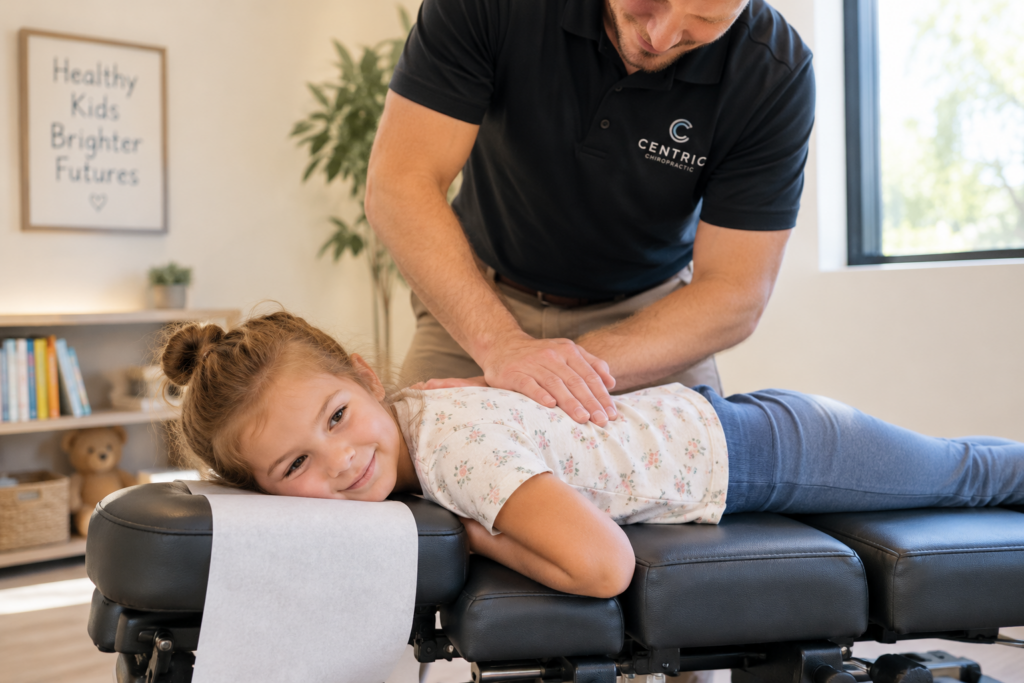
A newborn chiropractic adjustment is delivered with fingertip pressure so light that it is genuinely difficult for a watching adult to believe anything clinical is happening. The amount of force involved is less than the pressure used to check the softness of a ripe tomato. There is no cracking, no twisting, no thrust. The chiropractor gently evaluates the alignment and motion of each spinal segment and, where restriction is identified, applies a sustained, extremely light corrective input.
Most infants are completely undisturbed during the assessment and adjustment. Many relax visibly. A few fuss briefly, much as they might during any novel handling, and settle quickly. Parents who stay present and calm report that their infants model that calm remarkably well.
Toddlers (1 to 3 Years)
Toddlers present the unique clinical challenge of being mobile, opinionated, and not particularly interested in lying still. Pediatric chiropractors who work with this age group are skilled at adapting the assessment and adjustment to the child’s natural movement. Many assessments are done with the child on a parent’s lap, standing, or in whatever position the child is comfortable in. Adjustments are quick, specific, and tolerated remarkably well. Most toddlers are more interested in the table paper than in any discomfort from the adjustment.
School-Age Children (4 to 10 Years)
School-age children are typically the easiest pediatric chiropractic patients. They are old enough to understand a simple explanation of what is being done, curious enough to be engaged in the process, and physically responsive enough that the effects of adjustment are often immediately apparent. This is also the age group where we most commonly see the first signs of screen-related forward head posture, school-schedule-driven postural problems, and the structural consequences of year-round youth sports demands.
Adolescents (11 to 17 Years)
Teenagers receive care that is very similar to adult care, with adjusting forces scaled appropriately for their size and the consideration that many are in the middle of the adolescent growth spurt — a period of rapid spinal elongation that can unmask pre-existing structural patterns and create new vulnerability. Adolescents who have been in care since childhood often have notably better spinal mobility and structural integrity than age-matched peers who are starting chiropractic care for the first time. The investment of the earlier years is visible in the structural health of the adolescent spine.
Looking for a “pediatric chiropractor near me in Gilbert AZ,” “chiropractic for newborns and infants East Valley,” “kids chiropractic care Chandler Mesa,” or “family chiropractor Gilbert Arizona?” Centric Chiropractic offers pediatric chiropractic care for children at every stage of development. Call us to schedule your child’s first assessment.
Thinking About Pediatric Chiropractic Care as an Investment in Irreversible Development
Here is the framing that changes how most parents think about this:
Every stage of development is irreversible. The neural architecture your child builds at age 2 cannot be rebuilt at age 20. The postural patterns established at age 8 become the structural baseline the adult spine is built upon. The proprioceptive habits and motor programs encoded during the athletic development years are the foundation athletic performance is built on for life. The autonomic regulation patterns established in early childhood shape the stress resilience, immune competence, and emotional regulation of the adult.
This does not mean that problems cannot be addressed later. It means that addressing them later costs more, takes longer, and produces less complete outcomes than addressing them during the window when the architecture is still being built.
Pediatric chiropractic care is not about preventing your child from ever having a health problem. It is about ensuring that the most important developmental window of their life is supported by a spine and nervous system that are structurally sound and neurologically clear — so that the architecture they build during these years is the best possible version of what their biology is capable of producing.
Centric Chiropractic is a cash-pay clinic in Gilbert, AZ. We offer transparent, straightforward pricing for pediatric care at every age. There are no surprise bills and no insurance complications. Call us and we will tell you exactly what your child’s visit will cost before you ever book.
👶 Give Your Child’s Nervous System the Best Possible Start.
The window for supporting your child’s neurological development through a clear, subluxation-free spine is open right now — at whatever age your child is today. Call Centric Chiropractic in Gilbert, AZ to schedule your child’s assessment. We serve families across Gilbert, Chandler, Mesa, and Queen Creek, and we love being part of the foundation families build for their children’s health.
References
Australian Spinal Research Foundation. (2024). New study examines improved brain development in 37 children undergoing chiropractic care for correction of vertebral subluxation. https://spinalresearch.com.au
Haavik, H., et al. (2024). Neuroplastic responses to chiropractic care: Broad impacts on pain, mood, sleep, and quality of life. PMC. https://pmc.ncbi.nlm.nih.gov/articles/PMC11592102/
Keating, G., et al. (2024). Clinical practice guideline for best practice management of pediatric patients by chiropractors: Results of a Delphi consensus process. Journal of Integrative and Complementary Medicine, 30(3), 216–232. https://doi.org/10.1089/jicm.2023.0010
Misra, S. M., Jaber, O., & Long, C. (2024). Chiropractic care in children: A review of evidence and safety. Clinical Pediatrics, 64(7), 1028–1032. https://doi.org/10.1177/00099228241305202
Alcantara, J., Ohm, J., & Kunz, D. (2010). The safety and effectiveness of pediatric chiropractic. Explore, 5(5), 290–295.
Centers for Disease Control and Prevention. (2024). Early brain development and health. https://www.cdc.gov/ncbddd/childdevelopment/early-brain-development.html
Harvard Center on the Developing Child. (2024). Brain architecture. https://developingchild.harvard.edu/science/key-concepts/brain-architecture/