
Spinal Decompression Therapy and Chiropractic Care: Why They Work Better Together
How Centric Chiropractic in Gilbert, AZ Combines Two of the Most Powerful Conservative Spine Therapies Into One Integrated Care Plan
Centric Chiropractic | Gilbert, AZ | Serving Chandler, Mesa & Queen Creek
🛑 Scope of Practice Disclaimer
The information in this article is for educational purposes only and does not constitute medical advice. Neither chiropractic care nor non-surgical spinal decompression therapy, as practiced at Centric Chiropractic, diagnoses, treats, or cures any disease, illness, or medical condition. The focus of both therapies is supporting the structural and neurological conditions under which the body is best able to self-regulate, heal, and function. Results vary by individual, condition severity, and chronicity. Not every patient is a candidate for spinal decompression therapy — contraindications are screened for at your initial assessment. If you are experiencing neurological emergencies such as loss of bowel or bladder control or rapidly progressive weakness, seek emergency medical care immediately. These therapies are not a substitute for medical evaluation.
If you have been researching your options for disc-related back pain, sciatica, or a herniated disc, you have probably come across two terms: chiropractic care and spinal decompression therapy. You may have seen standalone spinal decompression therapy clinics advertising the therapy on its own. You may have been to a chiropractor who did not offer decompression. And you might be wondering: what is the difference, and which one do I actually need?
The answer, for most patients with disc-related conditions, is both — and the reason comes down to how these two therapies address different parts of the same problem.
At Centric Chiropractic in Gilbert, Arizona, we offer both specific chiropractic adjustments and non-surgical spinal decompression therapy as part of a fully integrated approach to disc and spinal health. This post explains exactly what each therapy does, why neither one alone is as complete as the two working together, and why the integration of these approaches under one roof — guided by one clinical team that understands your whole spine — produces outcomes that standalone approaches simply cannot match.
Two Therapies, Two Different Targets — Both Necessary
To understand why chiropractic and spinal decompression belong together, you first need to understand what each one actually does at a mechanical and physiological level. They are complementary by design — each reaching something the other cannot fully address on its own.
What Chiropractic Adjustments Do
A chiropractic adjustment is a specific, controlled input delivered to a restricted or subluxated spinal joint. Its primary mechanism is the restoration of proper motion and alignment to vertebral segments that have lost their normal range of motion due to injury, postural stress, or accumulated mechanical demand.
When a vertebral segment is subluxated — locked in a position of reduced motion — several downstream effects follow:
· The mechanical loading of the adjacent intervertebral disc becomes asymmetrical, concentrating compressive stress on one side of the disc and accelerating degenerative change
· The nerve roots exiting the spinal canal at that level experience increased mechanical tension and potential compression, creating neurological interference throughout the territory those nerves supply
· The paraspinal muscles surrounding the restricted segment go into protective guarding, adding further compressive load to an already stressed disc
· The segments above and below the restriction compensate by moving excessively, creating hypermobility that accelerates wear at the compensating levels
A specific chiropractic adjustment directly addresses all four of these effects. It restores proper motion to the restricted joint, reduces the asymmetrical disc loading, removes mechanical tension from the nerve root, releases paraspinal muscle guarding, and reduces the compensatory hypermobility above and below.
What a chiropractic adjustment cannot do — even a beautifully specific, perfectly delivered adjustment — is create the sustained negative intradiscal pressure needed to draw herniated disc material back toward center, or drive the nutrient diffusion into a dehydrated disc that has lost its structural integrity. For those mechanisms, a different tool is required.
What Non-Surgical Spinal Decompression Does
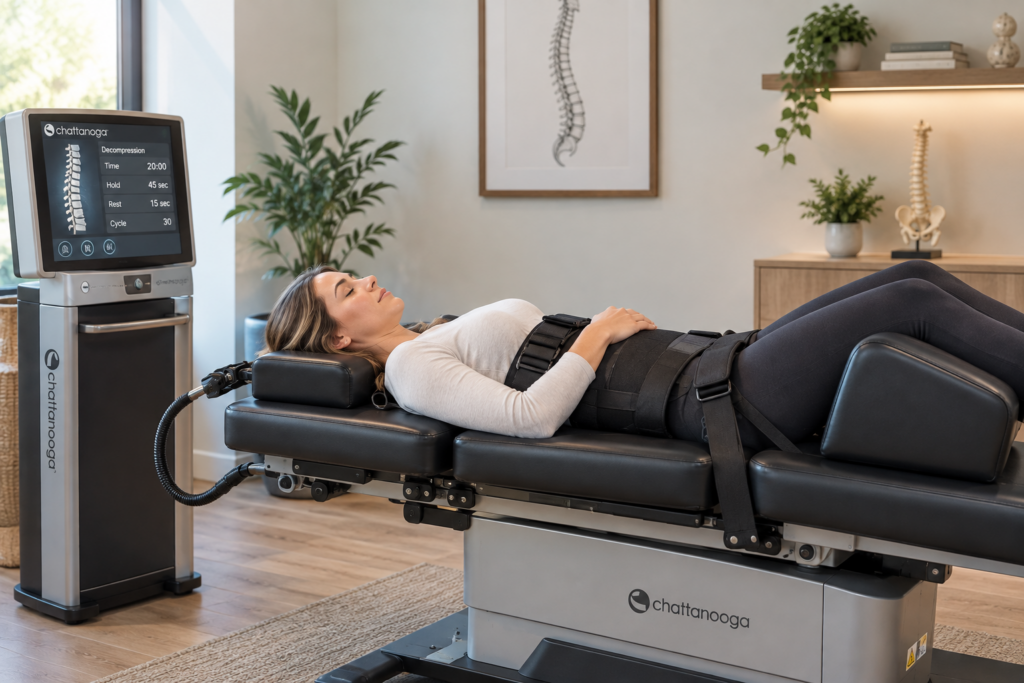
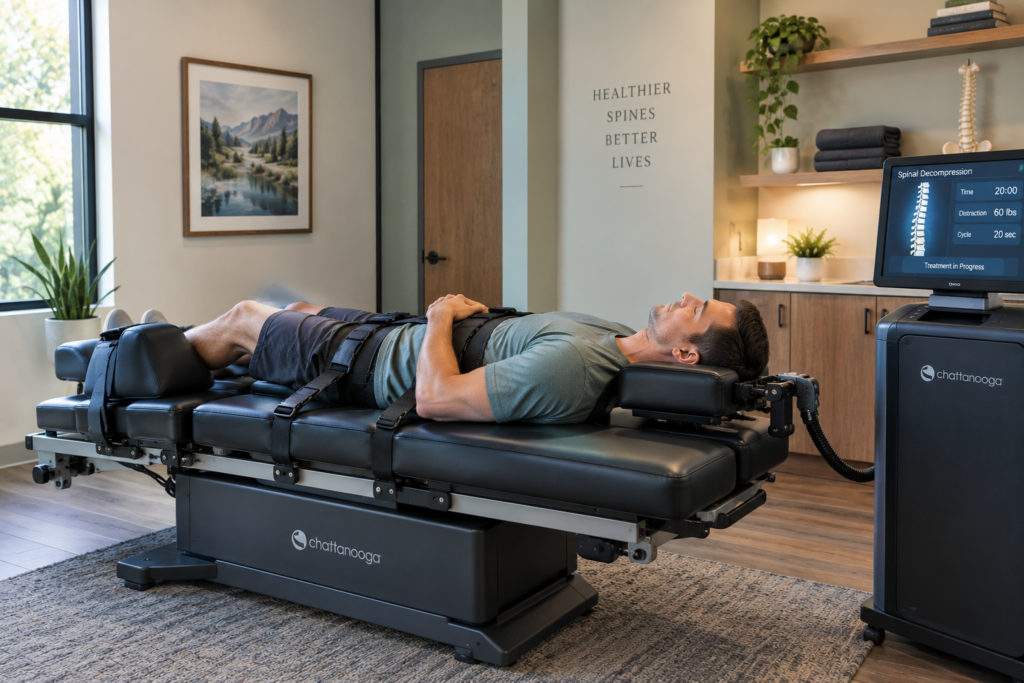
Non-surgical spinal decompression therapy uses a computer-controlled motorized table to create a precisely programmed distraction force through the spine — varying in magnitude, angle, and timing in a pattern specifically designed to achieve something conventional traction cannot: true negative intradiscal pressure.
When negative pressure is created within the disc, two things happen that no other conservative therapy produces:
· Herniated or bulging disc material is drawn back toward the center of the disc and away from the nerve root it has been compressing. This is a mechanical phenomenon driven by the pressure gradient created within the disc — and it is the reason recent MRI studies have documented measurable reductions in herniation volume following decompression protocols.
· The pressure differential between the disc interior and the surrounding tissue drives the passive diffusion of water, oxygen, glucose, and other essential nutrients back into the disc through the permeable endplates. Because the intervertebral disc has no direct blood supply, this diffusion-driven nutritional exchange is the primary mechanism through which the disc can rehydrate and begin structural recovery.
What decompression cannot do on its own is correct the subluxation patterns and joint restrictions that created the abnormal disc loading in the first place. If those patterns remain uncorrected, the mechanical conditions that caused the disc to herniate are still present, and the benefit of decompression is working against an ongoing structural problem.
Chiropractic adjustments address the mechanical environment of the spine — the joint restrictions, subluxations, and loading asymmetries that create the conditions for disc damage. Non-surgical spinal decompression addresses the disc itself — creating the negative pressure needed to reduce herniation and drive disc rehydration. Neither therapy is complete without the other for most disc-related presentations.
Why Standalone Decompression — Without Chiropractic — Often Falls Short
Non-surgical spinal decompression clinics have become increasingly common across the East Valley and the broader Phoenix metro area. Some are excellent. Others offer decompression as an isolated service without any assessment of the spinal mechanics that are feeding the disc problem.
Here is the clinical reality of standalone decompression without chiropractic correction:
Decompression Into a Subluxated Spine Is Less Effective
The effectiveness of decompression therapy is directly influenced by the mechanical state of the spine at the levels being treated. When the spinal segments adjacent to a herniated disc are subluxated and restricted — unable to move freely through their normal range — the decompression force is not delivered as precisely to the target disc. The restricted segments above and below the herniation interfere with the quality of distraction at the disc level, reducing the negative intradiscal pressure that is the therapy’s primary mechanism of action.
Chiropractic adjustments that restore proper motion to the segments adjacent to the target disc allow the decompression force to be more precisely and more fully expressed at the disc level. The decompression works better when the mechanical environment around the disc has been optimized first.
The Underlying Cause Goes Unaddressed
A herniated or degenerated disc does not develop in isolation. It develops because the spine has been under abnormal mechanical load — often for years — due to subluxation patterns, postural dysfunction, or asymmetrical loading from lifestyle and occupation. If those patterns are never identified and corrected, a patient may complete a full course of decompression therapy, experience meaningful improvement, and then watch the disc problem return within months because the mechanical environment that created it in the first place has never changed.
This is why so many patients who undergo decompression alone eventually need another course — and why patients who combine decompression with corrective chiropractic care tend to hold their results for longer.
The Nervous System Component Is Missed
Disc-related back pain is not only a structural problem — it is also a neurological one. The nerve root compression associated with a disc herniation creates neurological interference that affects not just local pain but also motor control, proprioception, and the broader regulatory functions of the nervous system. Chiropractic care addresses this neurological dimension directly, restoring the quality of nerve signal transmission through the affected levels and supporting the nervous system’s capacity to regulate and heal.
Decompression therapy reduces the mechanical compression on the nerve root. Chiropractic adjustments restore the neurological function that the compression has disrupted. Both are part of a complete recovery.
Searching for “spinal decompression and chiropractic Gilbert AZ,” “combined chiropractic and decompression therapy East Valley,” or “integrated disc treatment Gilbert Arizona?” Centric Chiropractic in Gilbert is one of the East Valley’s only clinics offering fully integrated chiropractic and non-surgical spinal decompression therapy under one roof, guided by one clinical team.
And Why Chiropractic Alone May Not Be Enough for Significant Disc Pathology
This is a conversation that honest chiropractors need to have with their patients.
Chiropractic care is extraordinarily effective for a wide range of spinal conditions — including many disc-related presentations. Restoring proper motion to the segments adjacent to a disc herniation, reducing the subluxation-driven compressive loading on the disc, and supporting nervous system function can produce meaningful clinical improvement even in patients with moderate disc herniations.
But for patients with:
· Large or extruded lumbar disc herniations causing significant nerve root compression
· Significant disc height loss from advanced degeneration
· Chronic disc-related pain that has not responded adequately to chiropractic adjustments alone
· Cervical disc herniations producing arm pain, numbness, or weakness that has been present for months
· Patients who have been told they are candidates for surgery and are seeking conservative alternatives
— chiropractic adjustments alone may not be sufficient to produce the disc-level change these presentations require. The adjustment can optimize the mechanical environment. But creating the negative intradiscal pressure needed to actually move disc material and drive disc rehydration requires decompression therapy.
Adding decompression to an existing chiropractic care plan for these patients is not an admission that chiropractic is failing. It is a recognition that significant disc pathology benefits from a more complete therapeutic approach — one that addresses both the mechanical environment of the spine and the disc itself.
📊 A 2025 meta-analysis published in Frontiers in Neurology concluded that mechanical spinal decompression therapy significantly outperformed standard physiotherapy alone for pain reduction and functional improvement in lumbar disc herniation patients — reinforcing the value of decompression as an additive therapy beyond what exercise and manipulation alone can achieve.
How Chiropractic and Decompression Work Together in a Single Care Plan
At Centric Chiropractic in Gilbert, the integration of chiropractic and decompression therapy is deliberate and sequenced. Here is how a typical integrated disc care plan unfolds:
Phase 1: Assessment and Preparation
Every integrated care plan begins with a thorough assessment of the full spine — not just the level of the disc complaint. We evaluate posture, spinal alignment, joint mobility throughout the cervical, thoracic, and lumbar spine, the specific disc levels involved, available imaging, and the neurological status of the affected nerve roots. We determine the appropriate decompression parameters (angle, force, duration, and frequency) for the specific presentation, and we identify the chiropractic priorities that will optimize the mechanical environment for decompression.
Phase 2: Chiropractic Adjustment Before or After Each Decompression Session
In most integrated protocols, chiropractic adjustments are delivered in coordination with decompression sessions — either immediately before or immediately after, depending on the clinical rationale for the individual patient. The sequencing matters:
Adjustment before decompression: Restoring motion to restricted segments before the decompression session begins ensures that the distraction force can be more precisely delivered to the target disc. This is the approach most commonly used when significant segmental restriction is identified adjacent to the herniated disc.
Decompression before adjustment: In some presentations, the decompression session first reduces acute disc-mediated nerve root compression, making the spine more accessible and comfortable for the adjustment that follows. This sequencing is sometimes used in highly acute presentations where significant nerve root irritation makes direct manipulation of the affected level uncomfortable as the first intervention.
The specific sequencing is a clinical judgment that we make based on your individual presentation — and it may shift throughout the course of care as your spine responds.
Phase 3: Rehabilitation and Stabilization
As the decompression protocol progresses and chiropractic adjustments are maintaining improved spinal mechanics, the care plan incorporates a rehabilitation component targeting the muscular and postural factors that created the abnormal disc loading in the first place. This may include:
· Specific exercises to strengthen the deep spinal stabilizers that protect the disc under load
· Hip and glute strengthening to reduce the lumbar spine’s compensatory burden during daily activity
· Postural retraining to address the forward head posture, anterior pelvic tilt, or other global alignment patterns that drove the disc problem
· Ergonomic and lifestyle guidance to reduce the daily mechanical stresses that are actively working against the structural changes being created in the clinic
Phase 4: Reassessment and Transition to Maintenance
At the completion of an integrated disc care plan, we reassess your clinical status comprehensively. For patients with significant disc pathology, follow-up imaging can document the structural changes that have occurred — the kind of MRI-confirmed reduction in herniation volume that recent 2024 and 2025 research has demonstrated is achievable for many patients.
Patients who have completed an integrated disc care plan are then transitioned to a chiropractic wellness schedule — periodic maintenance adjustments to keep the mechanical environment of the spine optimized and reduce the risk of recurrence. Some patients with significant disc pathology benefit from periodic decompression “booster” sessions on a monthly or quarterly basis to maintain disc health over the long term.
“I came in after two epidurals that didn’t last and a surgeon telling me I had two options — surgery or live with it. I did both the decompression and the chiropractic adjustments together for about six weeks. The combination was different from anything I’d tried before. The leg pain was gone by week four. I’m six months out now, still doing monthly maintenance adjustments, and I haven’t had a bad day since.” — Patient, Chandler, AZ
Who Benefits Most From Integrated Chiropractic and Decompression Care
While the integrated approach benefits a wide range of patients with disc-related conditions, certain presentations are particularly well-suited:
· Lumbar disc herniations with sciatica — especially when the leg pain has not fully responded to chiropractic adjustments alone
· Cervical disc herniations causing arm pain, numbness, or tingling — where cervical decompression combined with chiropractic care addresses both the disc compression and the segmental dysfunction
· Degenerative disc disease with chronic pain — where decompression supports disc rehydration and chiropractic maintains optimal segmental mechanics
· Patients who have completed a full course of chiropractic care with improvement but a plateau — adding decompression to an existing plan can break through that plateau
· Post-surgical patients with residual disc-related symptoms at non-fused levels
· Patients who have been recommended for surgery and are committed to exhausting every conservative option first
· Patients who completed a decompression program elsewhere without a chiropractic component and experienced recurrence — adding the chiropractic piece often produces more durable results
Looking for “chiropractic and spinal decompression Gilbert AZ,” “disc herniation treatment without surgery East Valley,” “integrated spine care Gilbert Arizona,” or “sciatica relief chiropractic and decompression Chandler Mesa?” Centric Chiropractic in Gilbert offers the East Valley’s most comprehensive integrated conservative disc care program.
Why Getting Both Therapies at Centric Chiropractic Makes a Difference
There are two ways to access spinal decompression therapy in the East Valley: at a standalone decompression clinic, or at a chiropractic clinic that offers decompression as part of a comprehensive care program.
Here is what is different about getting both therapies from a single clinical team at Centric Chiropractic in Gilbert:
· One provider assesses your entire spine and understands both the disc pathology and the spinal mechanics that are driving it — rather than treating the disc in isolation
· The decompression parameters are set based on a complete clinical picture that includes your chiropractic findings — not just a standard protocol applied to everyone with a disc herniation
· The sequencing of adjustments and decompression sessions is coordinated with clinical intention — each session builds on the last
· There is no miscommunication between your chiropractor and your decompression provider because they are the same person
· When something changes — when you have a bad day, when a new symptom appears, when your response to care shifts — we adapt the plan immediately rather than continuing a protocol that is no longer the best fit
· The transition from active disc care to wellness maintenance is seamless, because your care relationship does not end when your decompression protocol is complete
For patients with significant disc pathology, this level of clinical integration is not a minor convenience. It is the difference between a plan that is truly coordinated and one that is fragmented.
Centric Chiropractic is a cash-pay clinic, which means transparent pricing, no insurance complexity, and care that is designed around your clinical needs — not around what a payer will approve. We will give you a clear picture of what a complete integrated disc care program costs before you begin.
🦴 Ready to Address Your Disc Problem From Every Angle?
If you have been dealing with disc-related back pain, sciatica, or a herniated disc in Gilbert, Chandler, Mesa, or Queen Creek — and you want a care plan that addresses both the mechanical environment of your spine and the disc itself — call Centric Chiropractic today. We will assess your spine, explain exactly what we find, and tell you honestly whether integrated chiropractic and decompression therapy is the right path for your specific situation.
References
Frontiers in Neurology. (2025). Meta-analysis: Mechanical spinal decompression versus standard physiotherapy for lumbar disc herniation outcomes.
Di Modica, V. & Sciarrone, G. J. (2025). Quantitative evaluation of the effectiveness of non-surgical spinal decompression in patients with chronic lumbar disc herniation. Journal of Clinical and Diagnostic Research, 19(3), YC47–YC52.
PMC. (2025). Non-surgical spinal decompression and physiotherapy for double-level disc herniation at L4-L5 and L5-S1: A case report. https://pmc.ncbi.nlm.nih.gov/articles/PMC12198015/
Choi, E., et al. (2022). Effect of nonsurgical spinal decompression on intensity of pain and herniated disc volume in subacute lumbar herniated disc. Journal of Pain Research. https://www.ncbi.nlm.nih.gov/pmc/articles/PMC9553669/
American Chiropractic Association. (2024). What research shows about chiropractic care. https://www.acatoday.org/research/what-research-shows/
Apfel, C. C., et al. (2010). Restoration of disk height through non-surgical spinal decompression is associated with decreased discogenic low back pain. BMC Musculoskeletal Disorders, 11(155). https://doi.org/10.1186/1471-2474-11-155