
Non-Surgical Spinal Decompression Therapy in Gilbert, AZ
What It Is, How It Works, What the Research Shows, and Whether It Might Be the Missing Piece in Your Back Pain Recovery
Centric Chiropractic | Gilbert, AZ | Serving Chandler, Mesa & Queen Creek
🛑 Scope of Practice Disclaimer
The information in this article is for educational purposes only and does not constitute medical advice. Non-surgical spinal decompression therapy and chiropractic care, as practiced at Centric Chiropractic, do not diagnose, treat, or cure any disease, illness, or medical condition — including disc herniation, degenerative disc disease, or spinal stenosis. Spinal decompression therapy works by creating specific mechanical conditions within the spine that support the body’s own structural and healing processes. Improvements in pain and function that patients report reflect the body’s own capacity to respond when those conditions are established. This therapy is not appropriate for all patients. Contraindications exist and are screened for at your initial assessment. Spinal decompression therapy is not a substitute for medical evaluation. If you are experiencing severe neurological symptoms, loss of bowel or bladder control, or progressive weakness, seek emergency medical care immediately.
If you have been told your only option is surgery — or if you have been living with disc-related back pain, leg pain, or sciatica that has not responded to physical therapy, injections, or standard chiropractic care — there is a conversation we want to have with you.
Non-surgical spinal decompression therapy is one of the most clinically significant tools available for patients with disc-related spinal conditions. It is not widely understood by most patients, often confused with simple traction, and underutilized in the broader healthcare conversation around spine care. But the research supporting it — including several studies published in 2024 and 2025 — is increasingly compelling.
At Centric Chiropractic in Gilbert, Arizona, we offer non-surgical spinal decompression therapy as part of a comprehensive approach to disc-related conditions affecting the lumbar and cervical spine. This post explains exactly what decompression is, how it works physiologically, what the current evidence shows, who is a good candidate, and what you can expect from the process.
If you have been searching for an alternative to spine surgery, or simply want to understand all of your conservative care options before making any decisions, read this in full.
First: Understanding What Is Actually Happening in Your Disc
Before understanding how spinal decompression works, it helps to understand what is going wrong in the first place.
The intervertebral discs are the flexible, shock-absorbing structures that sit between the vertebrae of the spine. Each disc has a tough outer ring called the annulus fibrosus and a soft, gel-like interior called the nucleus pulposus. Together, these structures distribute compressive forces across the spine and allow the vertebrae to move relative to each other.
When a disc is healthy, the nucleus pulposus sits centrally within the annulus and maintains a high-water content that keeps the disc tall, pliable, and mechanically functional. When a disc is damaged — through injury, degeneration, sustained abnormal loading, or the cumulative effects of spinal subluxation — several things can happen:
· The disc can bulge — the nucleus shifts and pushes against the annulus without fully breaking through, causing the disc to protrude in one direction
· The disc can herniate — the annulus tears partially or completely, allowing the nucleus material to leak out and press against the adjacent nerve roots or the spinal cord itself
· The disc can dessicate — lose its water content, collapse in height, and lose its capacity to absorb and distribute load effectively
· The disc can develop fissures in the annulus that are a source of pain in their own right, even without herniation or nerve compression
These disc changes create the presentations most patients with disc-related back pain experience: local pain at the affected level, radicular pain that travels into the arms or legs along the path of the compressed nerve, and neurological symptoms including numbness, tingling, and weakness in the extremities.
The traditional medical approach to significant disc herniation has been a progression from pain management to injection to surgery. Non-surgical spinal decompression offers a conservative alternative that works at the level of the disc itself — not by masking pain, but by creating the mechanical and metabolic conditions under which the disc can change.
📊 Low back pain is the leading cause of disability worldwide, affecting approximately 619 million people globally (WHO, 2023). Lumbar disc herniation accounts for a significant proportion of this burden, and the majority of cases are initially managed conservatively. Surgery carries risks of failed back surgery syndrome in 10–40% of patients (Di Modica & Sciarrone, JCDR, 2025).
What Is Non-Surgical Spinal Decompression Therapy — and How Is It Different From Traction?
This is one of the most important distinctions to understand before evaluating decompression as an option.
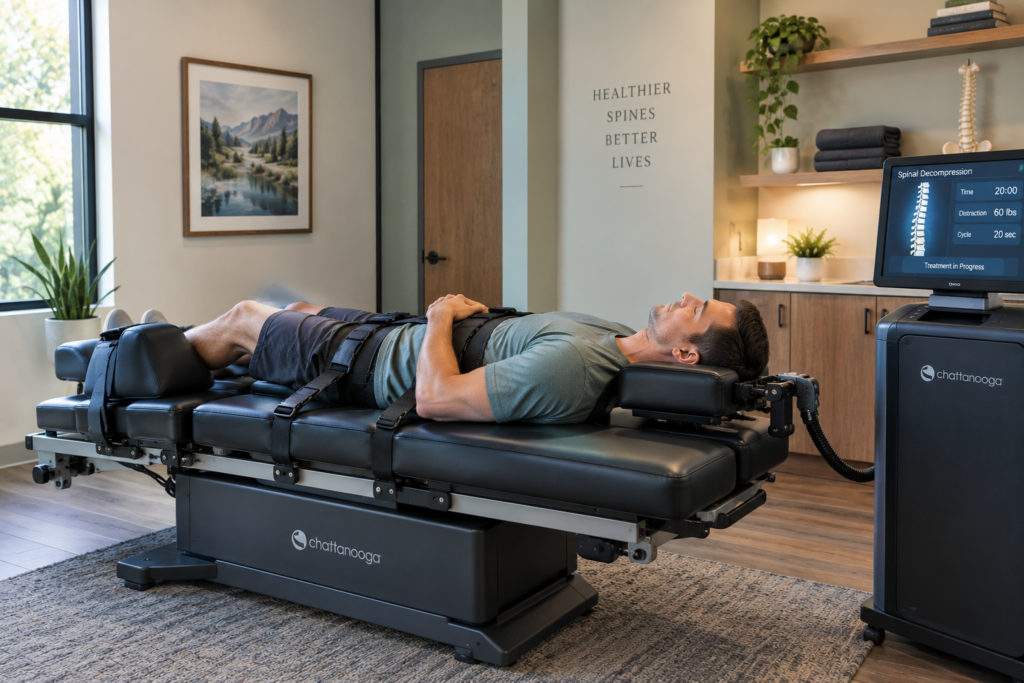
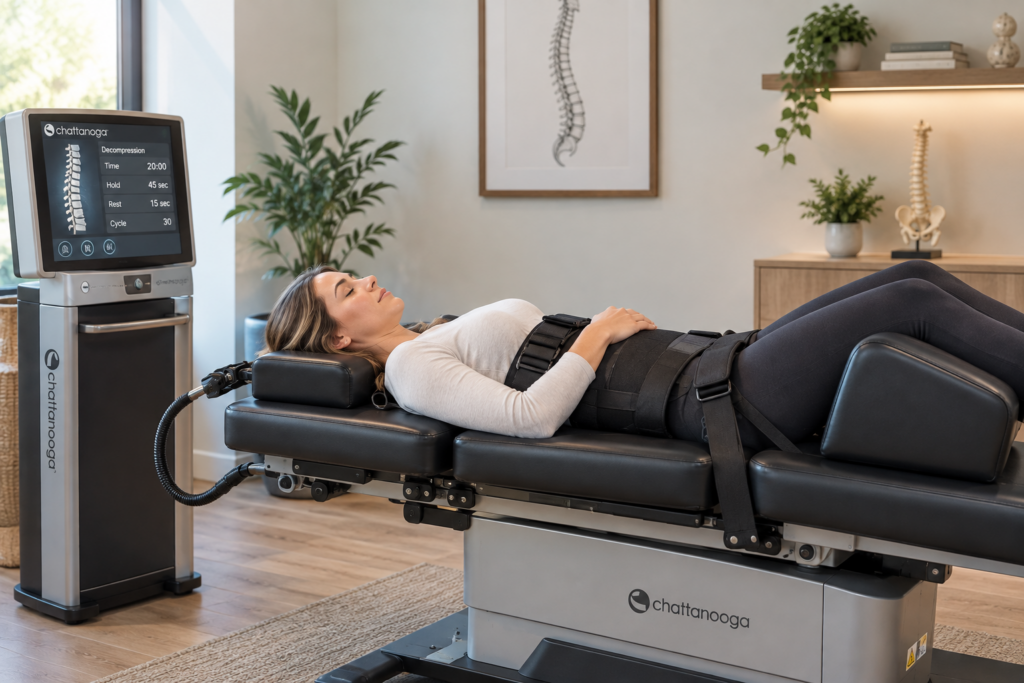
Non-surgical spinal decompression therapy (NSSD) is a computer-controlled, motorized therapy delivered on a specialized table that gently stretches the spine in a precisely programmed way. The protocol varies the distraction force, the angle of pull, and the timing of distraction and relaxation cycles in a pattern specifically designed to achieve a decompression effect within the intervertebral disc.
This is fundamentally different from conventional traction — and the difference matters clinically.
Why Conventional Traction Is Not the Same Thing
Conventional traction applies a sustained, constant pulling force to the spine. While it can provide temporary symptom relief through muscle relaxation and temporary joint separation, the body responds to a constant, predictable pull by contracting the paraspinal muscles to resist it — a reflex that can actually increase intradiscal pressure in some patients and limits how much true disc decompression occurs.
Non-surgical spinal decompression overcomes this limitation through a computer-controlled, oscillating distraction protocol. The varying force, angle, and rhythm of the decompression table’s pull is designed to stay below the threshold that triggers the paraspinal muscle contraction reflex — allowing true negative intradiscal pressure to develop within the disc itself.
The fundamental mechanism of non-surgical spinal decompression is the creation of negative intradiscal pressure — a genuine vacuum effect within the disc that draws herniated or bulging disc material back toward the center, and simultaneously draws in water, oxygen, and nutrients from the surrounding tissue into the disc. This is the biological basis for disc rehydration and the structural changes documented on post-treatment MRI imaging.
What Negative Intradiscal Pressure Does
When negative pressure — sometimes described as a gentle vacuum effect — is created within the disc during a decompression session, two important things happen simultaneously:
· The negative pressure gradient creates a mechanical force that draws bulging or herniated disc material back toward the center of the disc and away from the nerve root it has been compressing. This is the mechanism through which decompression therapy can reduce the nerve compression responsible for radicular pain, numbness, and weakness.
· The pressure differential between the disc interior and the surrounding tissue drives the diffusion of water, oxygen, glucose, and other nutrients into the disc through the permeable endplates. Because the intervertebral disc has no direct blood supply and depends entirely on this diffusion process for its nutritional support, this is the mechanism through which decompression therapy can genuinely support disc rehydration and structural recovery.
These two mechanisms — mechanical reduction of herniation and enhanced disc nutrition — are what distinguish non-surgical spinal decompression from pain management approaches that address symptoms without creating conditions for structural change.
What the Research Shows: A Growing and Compelling Evidence Base
The evidence base for non-surgical spinal decompression has grown substantially in the past several years. The most recent studies — published in 2024 and 2025 — are the most compelling yet, including MRI-confirmed structural changes in treated discs.
2025: MRI-Confirmed Disc Changes in 77% of Patients
📊 A 2025 study published in the Journal of Clinical and Diagnostic Research evaluated patients with chronic lumbar disc herniations. After 20 sessions of non-surgical spinal decompression therapy, 77% of patients demonstrated notable, measurable changes in their herniated discs — confirmed on MRI imaging. This included cases of complete disappearance of sequestered disc fragments in patients who had previously failed surgery, injections, and prolonged physical therapy. (Di Modica & Sciarrone, JCDR, 2025)
This is a clinically remarkable finding. MRI-confirmed structural changes in herniated discs — not just symptom improvement, but measurable changes in the actual disc pathology — represent a fundamentally different category of outcome than what pain management or even most conservative care approaches can produce.
2025: Double-Level Disc Herniation Successfully Managed Without Surgery
📊 A 2025 case report published in PMC documented a 46-year-old female with double-level disc herniation at L4-L5 and L5-S1. She had failed two conventional physiotherapy programs and had been advised by her physicians that surgery was her only remaining option. Following an intensive non-surgical spinal decompression protocol augmented with supportive physiotherapy, she achieved meaningful clinical improvement without surgery — a finding the authors described as demonstrating ‘promise in the non-invasive management of significant lumbar disc herniations, even when affecting multiple spinal levels concurrently.’ (PMC, 2025)
2025: Cervical Disc Herniation Responds to Non-Surgical Decompression
📊 A 2025 study published in ScienceDirect evaluated three patients with cervical disc herniations at C5-C6 or C6-C7 who had been unresponsive to standard physiotherapy. Following an intensive non-surgical spinal decompression protocol, all three patients demonstrated MRI-confirmed improvements in their cervical disc herniations. The findings extended the evidence for decompression therapy beyond the lumbar spine to include the cervical spine — a region with its own significant clinical burden of disc-related radiculopathy. (ScienceDirect, 2025)
2022: Seoul National University — Reduced Pain and Reduced Herniation Volume
📊 A peer-reviewed study from Seoul National University Bundang Hospital evaluated the effect of non-surgical spinal decompression therapy on both pain intensity and herniated disc volume in patients with lumbar disc herniation. Results showed statistically significant reductions in both pain scores and the measurable volume of the herniation following the decompression protocol — providing quantitative evidence that disc volume changes, not just symptom changes, occur with this therapy. (Choi et al., 2022)
2025: Meta-Analysis Confirms Decompression Outperforms Standard Physiotherapy
📊 A meta-analysis published in Frontiers in Neurology (2025) analyzed outcomes across multiple randomized controlled trials comparing mechanical spinal decompression to standard physiotherapy in lumbar disc herniation patients. The conclusion: mechanical decompression significantly outperformed conventional physiotherapy in reducing pain and improving functional outcomes.
Taken together, this body of evidence — particularly the MRI-confirmed structural changes documented in the most recent studies — represents a meaningful and growing scientific foundation for non-surgical spinal decompression as a primary conservative care option for disc-related spinal conditions.
Which Conditions Does Non-Surgical Spinal Decompression Address?
Non-surgical spinal decompression therapy is indicated for a specific set of disc-related conditions. It is not a treatment for all back pain — and part of the value of working with a trained provider is the assessment process that determines whether you are a good candidate.
Conditions for which spinal decompression therapy has demonstrated clinical benefit include:
Lumbar Disc Herniation
Herniated discs in the lower back are the most common indication for non-surgical spinal decompression. Whether the herniation is causing local low back pain, sciatica (shooting leg pain), or both, lumbar decompression creates the negative intradiscal pressure needed to reduce the mechanical compression on the affected nerve root and support structural recovery of the disc.
Bulging or Protruding Lumbar Discs
A bulging disc — in which the disc material is pushing outward against the annulus without a complete tear — responds to decompression therapy by reducing the bulge through the same negative pressure mechanism. Many patients with bulging discs that are compressing nerve roots experience significant improvements in radicular symptoms with a course of decompression therapy.
Degenerative Disc Disease
Degenerative disc disease involves the progressive loss of disc height, water content, and structural integrity that occurs as discs age and are subjected to cumulative mechanical stress. The disc nutrition mechanism of decompression therapy — driving the diffusion of water and nutrients back into the disc — is particularly relevant for degenerative discs that have become dehydrated and are continuing to lose height. Decompression therapy cannot reverse established degeneration, but it can support a better nutritional environment for the remaining disc tissue.
Lumbar Spinal Stenosis
Spinal stenosis refers to the narrowing of the spinal canal or the intervertebral foramina through which nerve roots exit. When stenosis is driven by disc height loss and facet joint hypertrophy — rather than purely bony narrowing — decompression therapy can create temporary but meaningful separation of the affected levels, reducing the compressive load on the stenotic neural structures. Patients with neurogenic claudication — the leg pain and heaviness that develops with walking and is relieved by sitting — are among those who may respond well.
Sciatica From Disc Compression
Sciatica — the shooting, burning, or electric pain that travels from the lower back through the buttock and into the leg — is often caused by a herniated or bulging lumbar disc compressing the sciatic nerve root. When the source of the nerve compression is disc material rather than bony stenosis, non-surgical decompression addresses the mechanical driver of the sciatica directly.
Failed Conservative Care or Post-Surgical Residual Pain
One of the most significant clinical applications of non-surgical spinal decompression is for patients who have already tried physical therapy, chiropractic care, and/or injection therapy without lasting relief — and for patients who have undergone spinal surgery but still have residual disc-related symptoms. The 2025 JCDR study included patients who had failed surgery, injections, and extended physical therapy and still achieved MRI-confirmed disc changes with decompression.
Cervical Disc Herniation and Cervical Radiculopathy
Non-surgical spinal decompression is not limited to the lumbar spine. Cervical decompression — applied with a specialized cervical traction attachment and modified protocol — has demonstrated efficacy for patients with cervical disc herniation causing arm pain, numbness, or weakness. The 2025 ScienceDirect study specifically documented MRI-confirmed improvements in cervical disc herniations with this approach.
Searching for “spinal decompression therapy Gilbert AZ,” “non-surgical disc treatment East Valley,” “sciatica treatment without surgery Gilbert,” “disc herniation treatment Gilbert AZ,” or “spinal decompression near me Chandler Mesa?” Centric Chiropractic in Gilbert, AZ offers non-surgical spinal decompression therapy as part of a comprehensive, conservative approach to disc-related spinal conditions.
Who Is Not a Candidate for Spinal Decompression Therapy?
Non-surgical spinal decompression is not appropriate for everyone. Clear contraindications exist and are screened for at your initial assessment at our Gilbert clinic. You are likely not a candidate if you have:
· Spinal fractures or a history of recent spinal trauma that has not been fully healed and cleared
· Spinal tumors or metastatic disease affecting the spine
· Spinal instability — including spondylolisthesis (vertebral slippage) beyond Grade 1
· Severe osteoporosis with high fracture risk
· Aortic aneurysm or significant vascular disease in the abdominal region
· Cauda equina syndrome — a neurological emergency involving loss of bowel or bladder control requiring immediate surgical intervention
· Active inflammatory arthropathy such as rheumatoid arthritis affecting the spine
· Pregnancy
· Implanted spinal hardware such as fusion cages, rods, or pedicle screws at the levels to be decompressed
Before beginning any course of decompression therapy, we conduct a comprehensive health history, review available imaging, and perform a clinical assessment to confirm that decompression is appropriate for your specific presentation. If you are not a candidate, we will tell you clearly and help you identify the most appropriate next step.
How Spinal Decompression and Chiropractic Care Work Together
At Centric Chiropractic in Gilbert, non-surgical spinal decompression is not offered in isolation. It is delivered as part of a comprehensive care plan that integrates chiropractic adjustments, disc-specific rehabilitation, and lifestyle guidance into a coordinated approach to disc health.
Here is why this integrated approach matters:
Chiropractic Adjustments Optimize the Mechanical Environment
The effectiveness of spinal decompression is significantly influenced by the mechanical environment of the spine at the levels being decompressed. When subluxations are present — joint restrictions that create abnormal loading and altered segmental mechanics — the decompression force may not be delivered as precisely or as effectively to the target disc. Specific chiropractic adjustments that restore proper motion to the spinal segments adjacent to the affected disc optimize the mechanical environment in which decompression occurs, making the decompression therapy more targeted and more effective.
Decompression Addresses What Adjustments Cannot Fully Reach
Conversely, chiropractic adjustments — while powerful tools for restoring joint motion and reducing nerve interference — do not create the sustained negative intradiscal pressure that drives disc rehydration and the reduction of herniated material. For patients with significant disc pathology, decompression therapy reaches the disc in a way that adjustments alone cannot. The two therapies are complementary by design.
Reducing Inflammation and Supporting Healing
A complete disc care program also addresses the inflammatory environment around the affected disc. Physiotherapy modalities, specific exercises, and lifestyle recommendations are incorporated into the care plan to support the body’s own inflammatory resolution and tissue repair processes alongside the mechanical work of the decompression sessions.
“I was told by my spine surgeon that I needed a microdiscectomy for my L4-L5 herniation. I had already done two rounds of physical therapy and a cortisone injection. Before committing to surgery, a friend suggested I try spinal decompression. After 15 sessions combined with chiropractic adjustments, the leg pain was gone. I had a follow-up MRI and the herniation had visibly reduced. I never had the surgery. That was two years ago and I am still doing well.” — Patient, Gilbert, AZ
What a Course of Non-Surgical Spinal Decompression Looks Like
If you come to Centric Chiropractic in Gilbert for non-surgical spinal decompression therapy, here is what the process looks like from first assessment through the completion of a care plan:
Initial Assessment and Candidacy Evaluation
Your first visit includes a thorough health history, a review of any available imaging (X-rays, MRI), and a clinical examination of your spine and nervous system. We assess whether you are a candidate for decompression therapy, identify the specific levels to be targeted, determine the appropriate decompression parameters (force, angle, duration) for your presentation, and explain exactly what the process involves before we begin.
A Typical Decompression Session
You lie on the decompression table fully clothed. A pelvic harness is comfortably fitted around your hips and lower back (for lumbar decompression) or a cervical collar attachment is fitted around your neck (for cervical decompression). The table’s computer-controlled mechanism then executes the programmed decompression protocol — applying varying degrees of distraction force at specific angles, alternating between distraction and relaxation cycles over the course of the session.
Each session typically takes 20 to 30 minutes. Most patients find the experience comfortable and relaxing. Many report a gradual reduction in pain or a sense of relief during and after the session. Some patients experience mild soreness afterward, particularly in the early stages of treatment, as the disc and surrounding structures begin to respond.
How Many Sessions Are Needed?
The number of sessions needed varies based on the severity and chronicity of the disc pathology, the specific levels involved, and how the individual patient’s body responds. Research protocols and clinical experience consistently suggest that meaningful disc change typically requires a sustained course of treatment rather than a handful of sessions.
· Most clinical protocols involve between 15 and 24 sessions, typically delivered 3 to 5 times per week in the initial phase
· The 2025 JCDR study that demonstrated 77% MRI-confirmed disc changes used a protocol of 20 sessions
· Patients who show early positive response and continue through the full course consistently achieve better outcomes than those who stop when initial symptom relief occurs
· A home care and rehabilitation component is incorporated from early in the program to support the structural changes being created during in-clinic sessions
Monitoring Progress
We reassess your clinical status regularly throughout the course of treatment. For patients with significant disc pathology, follow-up imaging after completing a course of decompression can document the structural changes that have occurred — the kind of MRI-confirmed outcome data that the 2025 research demonstrates is achievable for many patients.
Looking for “spinal decompression therapy near me Gilbert AZ,” “linked disc herniation treatment Chandler Mesa,” “back pain alternative to surgery East Valley,” or “sciatica treatment Gilbert Arizona without surgery?” Centric Chiropractic in Gilbert, AZ provides non-surgical spinal decompression therapy combined with specific chiropractic care for patients with disc-related conditions across the East Valley.
Common Questions About Non-Surgical Spinal Decompression
Does it hurt?
Most patients find spinal decompression therapy comfortable and relaxing. The distraction force is applied gradually and gently. Patients who are in significant acute pain may notice some discomfort during the early sessions as the tissues begin to respond to the new mechanical conditions, but frank pain during the session is unusual and would prompt us to modify the protocol immediately.
How does it compare to surgery?
Surgery remains the appropriate choice for specific presentations — primarily cauda equina syndrome, progressive neurological deficit not responding to conservative care, or disc pathology that has genuinely failed all conservative options. For the much larger population of patients with disc herniation and radiculopathy who do not have those presentations, the evidence increasingly supports conservative care — including spinal decompression — as the first-line approach. A 2024 systematic review confirmed that surgery does not consistently outperform conservative care at 12-month follow-up in patients without neurological emergency.
What if I’ve already had surgery?
Post-surgical spinal decompression is possible in many cases, depending on the type of surgery performed and the levels involved. Patients with residual or recurrent disc symptoms after surgery are often candidates for decompression therapy at levels that were not surgically fused or instrumented. We evaluate each post-surgical patient individually and carefully before making any recommendations.
Is it covered by insurance?
Centric Chiropractic is a cash-pay clinic. We do not bill insurance. Non-surgical spinal decompression therapy is priced transparently, and many patients find that when the cost of decompression is compared to the cost of an epidural steroid injection series, the co-pays and deductibles of extended physical therapy, or the out-of-pocket costs of spinal surgery, decompression represents an extremely cost-effective conservative option. Many patients use their HSA or FSA accounts to cover decompression therapy costs.
🦴 Before You Agree to Surgery, Let’s Talk About Decompression.
Non-surgical spinal decompression therapy has helped patients across Gilbert, Chandler, Mesa, and Queen Creek avoid surgery, recover from disc herniations, and get back to the lives they love. Call Centric Chiropractic in Gilbert, AZ today to schedule your decompression candidacy assessment. You deserve to understand all of your options before making any decision.
References
Di Modica, V. & Sciarrone, G. J. (2025). Quantitative evaluation of the effectiveness of non-surgical spinal decompression in patients with chronic lumbar disc herniation. Journal of Clinical and Diagnostic Research, 19(3), YC47–YC52.
PMC. (2025). An intensive non-invasive protocol combining non-surgical spinal decompression and supportive physiotherapeutic modalities in the treatment of double-level disc herniation at L4-L5 and L5-S1: A case report. https://pmc.ncbi.nlm.nih.gov/articles/PMC12198015/
ScienceDirect. (2025). Effect of an intensive non-invasive program including spinal decompression on MRI-assessed structural changes in cervical disc herniation. https://www.sciencedirect.com/science/article/pii/S2214751925000751
Choi, E., Gil, H. Y., Ju, J., Han, W. K., Nahm, F. S., & Lee, P. B. (2022). Effect of nonsurgical spinal decompression on intensity of pain and herniated disc volume in subacute lumbar herniated disc. Journal of Pain Research. https://www.ncbi.nlm.nih.gov/pmc/articles/PMC9553669/
Frontiers in Neurology. (2025). Meta-analysis: Mechanical spinal decompression versus standard physiotherapy for lumbar disc herniation.
World Health Organization. (2023). Low back pain. https://www.who.int/news-room/fact-sheets/detail/low-back-pain
Apfel, C. C., et al. (2010). Restoration of disk height through non-surgical spinal decompression is associated with decreased discogenic low back pain. BMC Musculoskeletal Disorders, 11(155). https://doi.org/10.1186/1471-2474-11-155